Table of contents
Author: Javier M. Floren, Founder of 3DforScience
Are you interested in modular content and omnichannel materials?
Introduction: The Shift from Flat to Interactive Visuals
The life sciences are awash with data. From genomic sequences and molecular structures to patient scans and clinical trial results, the sheer volume of information generated daily is staggering. For decades, we’ve relied on 2D representations – graphs, charts, static images – to make sense of this complexity. While invaluable, these flat depictions often struggle to convey the intricate spatial relationships, dynamic processes, and multi-layered nature inherent in biological systems. It’s time to step into a new dimension. Transforming this data into interactive 3D models is revolutionizing how we understand, share, and engage with scientific information, paving the way for deeper insights and even richer experiences in mixed reality environments.
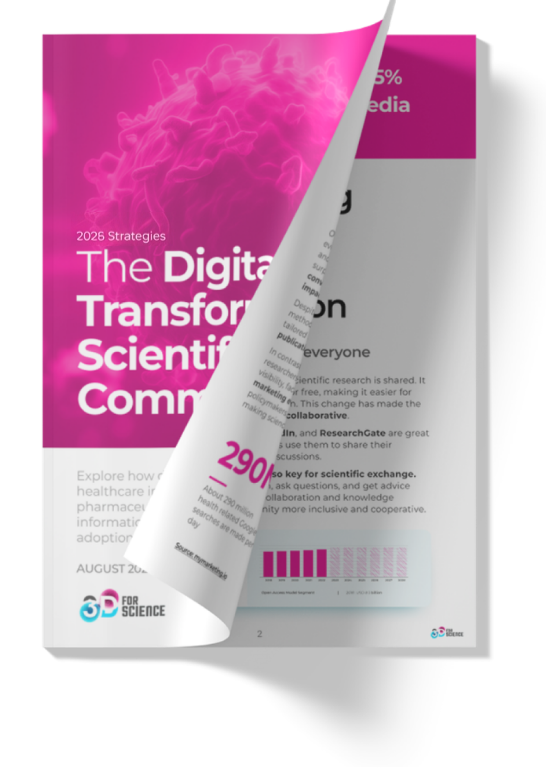
Get this free Guide with
5 key steps for The Digital Transformation
of Scientific Communication
The Flatland Challenge: Limitations of 2D Data Visualization
Imagine trying to understand the precise fit of a drug molecule into its receptor protein from a series of 2D diagrams, or comprehending the complex branching of the vascular system from a flat illustration. Traditional 2D visualization methods, while useful, inherently face limitations:
-
Obscured Spatial Relationships: Depth, volume, and true three-dimensional structure are often lost or require significant mental reconstruction.
-
Difficulty Representing Dynamic Processes: Static images cannot effectively show processes that unfold over time or involve movement and interaction.
-
Oversimplification: To fit into a 2D plane, complex multi-faceted datasets may be oversimplified, potentially hiding crucial details or nuances.
-
Cognitive Load: Users must mentally piece together multiple 2D views to build a 3D understanding, which can be taxing and prone to misinterpretation.
These limitations can hinder research, slow down learning, and make it challenging to communicate complex scientific concepts effectively to diverse audiences.

Stepping into the Third Dimension: What Makes Interactive 3D Models a Game-Changer?
Interactive 3D models convert complex datasets into dynamic, explorable virtual objects. Unlike static images or passive animations, they invite users to engage directly with the information:
-
True Spatial Understanding: They accurately depict the three-dimensional nature of biological structures, from molecules to whole organisms, allowing for an intuitive grasp of form and relationships.
-
Dynamic Exploration: Users can rotate, zoom, pan, and even dissect models, or trigger animations to observe processes from any angle, fostering a deeper, self-directed learning experience.
-
Data Layering & Integration: Multiple datasets (e.g., anatomical structures, gene expression levels, drug binding sites) can be overlaid and toggled within a single, cohesive 3D model.
-
Enhanced Engagement & Retention: The immersive and hands-on nature of interactive 3D models makes learning more captivating, leading to improved understanding and knowledge retention.

The Transformation Process: From Raw Data to Interactive Experience
Creating these powerful tools involves a sophisticated blend of scientific rigor and visual artistry:
-
Data Acquisition & Processing: Gathering and preparing the foundational data, which could be anything from medical imaging (MRI, CT), microscopy data, genomic or proteomic datasets, to outputs from computational simulations.
-
Accurate 3D Modeling: Constructing scientifically accurate 3D geometries based on the data.
-
Texturing & Visual Refinement: Applying realistic textures, colors, and lighting to enhance visual clarity and aesthetic appeal.
-
Interactivity Programming: Implementing user controls, data toggles, animations, and other interactive features.
-
Platform Deployment: Optimizing and delivering the model for various platforms, such as web browsers, standalone applications, or immersive VR/AR systems.
This process transforms raw, often abstract, data into an intuitive and engaging experience.
Applications Across the Life Sciences Spectrum
The impact of interactive 3D models is being felt across numerous areas:
-
Drug Discovery & Development: Visualizing protein-ligand interactions, exploring potential drug targets in 3D, and understanding complex mechanisms of action.
-
Medical Education & Training: Providing medical students and professionals with interactive anatomical atlases, virtual dissection tools, and realistic surgical simulators.
-
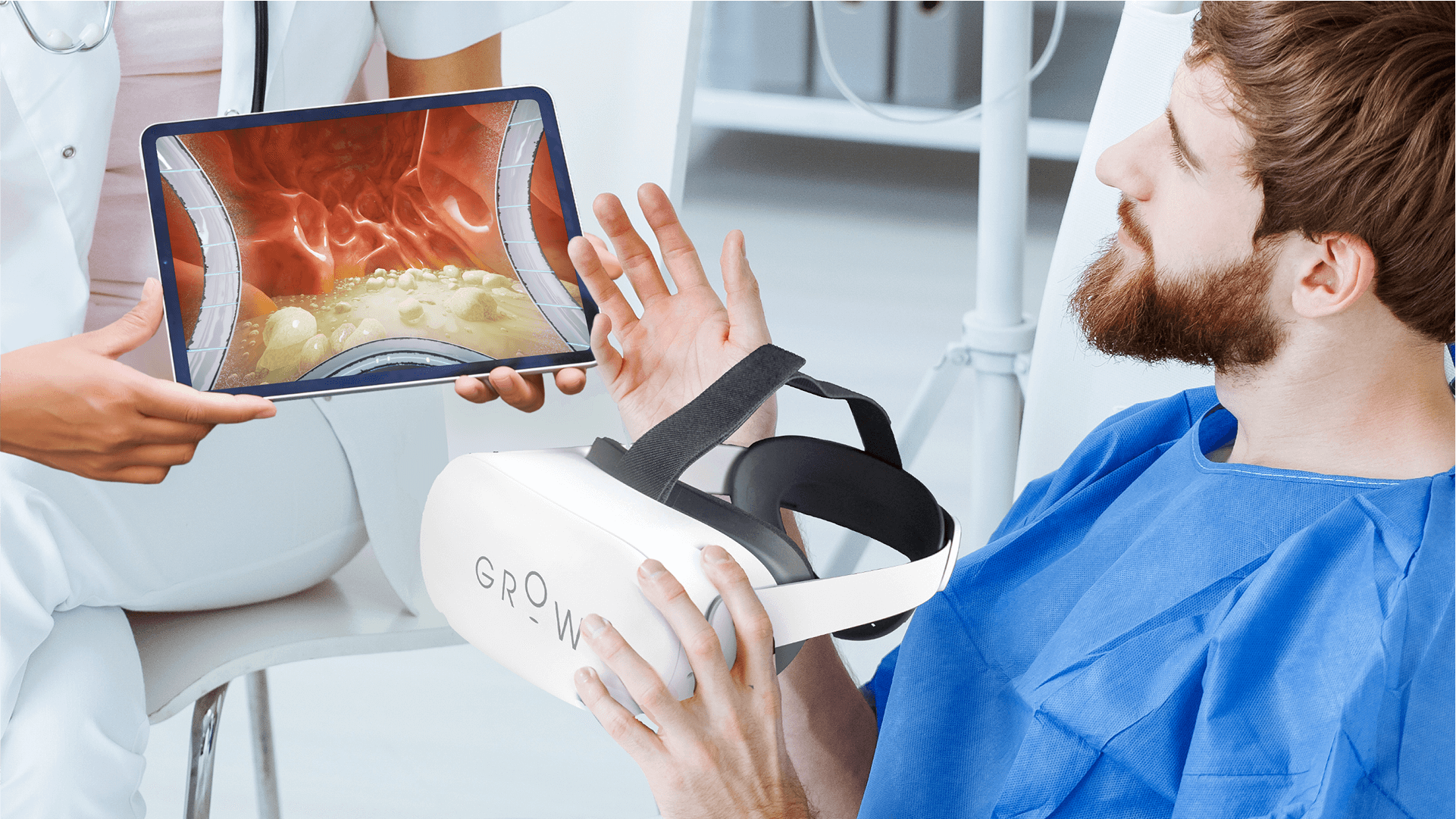
Patient Communication: Empowering doctors to explain complex medical conditions, surgical procedures, or the way a new therapy works to patients using clear, easy-to-understand 3D visuals.
-
Medical Device Innovation: Allowing engineers to prototype, visualize, and interactively demonstrate the mechanics and usability of new medical devices.
-
Scientific Publishing & Conferences: Enabling researchers to present their findings in a more dynamic and engaging way, moving beyond static posters and slides.
Beyond the Screen: Interactive 3D Models as Gateways to Mixed Reality Environments
The journey doesn’t end with the computer screen. These rich, interactive 3D models are the fundamental building blocks for even more immersive and intuitive experiences within mixed reality environments. Mixed reality (MR) encompasses the spectrum from Augmented Reality (AR), which overlays digital information onto the real world, to Virtual Reality (VR), which creates fully immersive digital environments.
Imagine:
-
Surgeons using AR to see a patient’s interactive 3D anatomical model precisely overlaid on their body during an operation.
-
Researchers collaborating in a shared VR space to manipulate and analyze a complex molecular structure in real-time.
-
Students “walking through” a virtual cell to understand its organelles and processes in an unprecedented way.
The interactivity embedded in the 3D models is what makes navigation, data exploration, and meaningful engagement within these mixed reality environments possible. These technologies are no longer science fiction; they are increasingly becoming practical tools for discovery and learning.
Conclusion: Embracing a New Dimension of Insight
The transformation from static 2D data to interactive 3D models represents a profound shift in how we interact with and comprehend scientific information. It’s about moving beyond passive observation to active exploration and experiential learning. By embracing this third dimension, the life sciences community can unlock new levels of insight, foster greater collaboration, accelerate innovation, and ultimately, improve outcomes. The future of data isn’t just about volume; it’s about depth, interactivity, and the ability to truly experience the science.

Ready to Bring Your Data to Life in 3D?
Don’t let your complex scientific data remain confined to flatland. 3DforScience specializes in transforming multifaceted datasets into engaging, scientifically accurate, and interactive 3D models that captivate and clarify.
Let us help you visualize your science in a new dimension, from interactive web-based solutions to foundational assets for cutting-edge mixed reality environments.