Table of contents
Author: Javier M. Floren, Founder of 3DforScience
Are you interested in modular content and omnichannel materials?
High-stakes learning needs more than “one-size-fits-all”
Pharma and MedTech training lives at the intersection of science, regulation, and real-world workflow. Generic, off-the-shelf courses rarely cover the specifics that matter: nuanced claims language, device-tissue interaction, role differences (R&D vs. MSL vs. field clinical), and the pace of product change. Teams need learning that mirrors their context, not a generic slideshow with new logos.

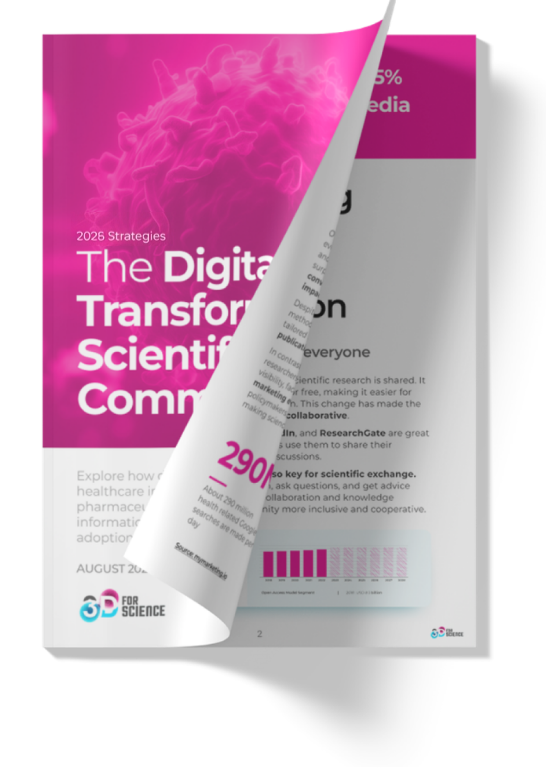
Get this free Guide with
5 key steps for The Digital Transformation
of Scientific Communication
Why Generic Training Fails in Pharma and MedTech
-
Regulatory nuance: Life-sciences teams operate under FDA/EMA scrutiny; templated courses won’t reflect product- and label-specific limits.
-
Complex science: Dense mechanisms and procedures demand visual explanation (e.g., medical animation for MoA or medical device animation for procedural steps).
-
Role specificity: A manufacturing tech and a field clinical specialist don’t need the same content, format, or depth.
-
Global reality: Localization, updates, and affiliate workflows require modular, update-friendly content—not re-authoring from scratch.
-
Point-of-need gaps: Learning must be available in the moment (before a case, on a ward, or in a demo).
These are precisely the shortcomings documented when organizations rely on generic programs instead of context-specific elearning built for pharma and devices.

What works instead: custom, scenario-led, modular
The strongest programs share a few traits:
-
Scenario-based practice: Realistic cases (device setup, adverse event handling, sampling steps) improve transfer to the clinic.
-
Microlearning: Short, focused modules lift completion and retention for time-starved clinicians and field teams.
-
Performance support: Job aids, quick-refs, and searchable clips close the “forgetting” gap at the point of care or demo.
-
Assessment aligned to the work: Frequent checks and feedback against the actual SOP/procedure reduce errors faster than end-of-course quizzes.
These patterns consistently outperform generic courses in engagement, competency, and operational outcomes.
Design for the way teams actually work
-
Mobile-first delivery: Field reps and clinical specialists learn between cases and visits; content must load fast, work offline when needed, and make sense on mute.
-
Immersive & interactive where it counts: Sim/VR for hands-on device skills; layered medical animation to visualize MoA, dose paths, or implant mechanics; clickable decision trees for compliance steps.
-
Adaptive pathways: Let experts skip what they know and focus on the gaps; route novices through foundational science first.
A practical playbook (use it tomorrow)
-
-
Define audience roles and risk points.
-
Map the real workflow (where mistakes or friction occur).
-
Storyboard short, reusable capsules (problem → action → outcome).
-
Build a visual library (animation + UI motion + job aids) that plugs into CLM/LMS.
-
Localize once, update centrally; let changes cascade.
-
Track what matters: time-to-proficiency, deviations, help-desk tickets, retraining triggers.
-
Why Custom Training Beats Generic Training
Generic training is cheaper on day one, and costlier every day after. In regulated, technical markets, clarity, context, and speed win. Custom, visual, modular learning turns training from a checkbox into a competitive advantage. If your value is scientific and procedural, make it visible and make it fit the work.

3DforScience: Your Medical Device Animation Partner
We craft modular, regulator-ready visual ecosystems—medical animation and medical device animation—for diagnostics, healthcare biotech, software/apps, and devices. Whether you’re explaining imaging AI, scaling procedure training, or aligning diagnostics messaging across affiliates, we translate complex science into clear, reusable assets.
Javier M. Floren, Founder of 3DforScience
https://www.linkedin.com/in/javiermartinfloren/
Javier Martín Floren, founder and CEO of 3DforScience, is a benchmark in visual communication for the life sciences sector, with over 12 years leading 3D animation, virtual reality, and scientific storytelling projects for pharmaceutical and biotechnology companies. Recognized as one of the Top 100 Healthtech Exponentialists by Zallud in 2024 and awarded the Leadership Award in Healthcare 2.0 in Dubai 2024, he drives innovation in digital health and the development of new scientific-technological profiles. He also leads ScienceStory, an AI-powered platform that enables scientists and healthcare professionals to create impactful medical animations in an agile and accessible way.