Table of contents
- What Is Modular Content in Pharma
- Modular Content Strategy: How to Build It Step-by-Step
- Common Modular Content Examples in Pharma
- How Modular Content Improves Omnichannel Performance
- The Role of Medical, Legal and Regulatory in Modular Content
- How 3DforScience Supports Modular Content in Pharma
- Framework: The 3DforScience Modular Content Blueprint
- Case Study: Transforming Pharma Content Pipelines With Modular Design
- Tools and Platforms to Enable Modular Content in Pharma
- Future Trends: AI Assisted Modular Content Creation
- Final Thoughts
- FAQs
Author: Javier M. Floren, Founder of 3DforScience
When a pharma Marketing Director is “finally fixing their content problem”, we already know what will happen next.
They will say they want faster approvals, global consistency, better omnichannel engagement and a content supply chain that does not collapse every time a new clinical update is released.
And yet, when we ask how they plan to get there, the answer is almost always the same.
They want to create more content, not better content.
This is where the gap begins.
Pharma does not need more assets. Pharma needs a system. A structure.
A repeatable and scientifically solid way of creating, validating and scaling material across channels and affiliates.
In other words, what they really need is modular content.
Are you interested in modular content and omnichannel materials?
What Is Modular Content in Pharma
Imagine a global brand team publishes a new MoA animation.
Affiliates love it, but they need shorter versions, versions with different claims, versions for congress screens, versions for non-HCP audiences and versions that include the latest local regulatory notes.
The original video was great, but it was never designed to be modular.
Every adaptation becomes a new asset.
Every new asset becomes a new MLR cycle.
Modular content changes this dynamic completely.
It is a structured ecosystem of reusable building blocks that contain approved copy, claims, references, scientific statements, visual assets and metadata.
These blocks can be assembled and adapted repeatedly without starting from zero each time.
In regulated environments, this matters deeply.
Modular content in pharma ensures that scientific accuracy, compliance language and safety statements remain stable across every channel and every market, even as assets multiply.
It is about designing content so it can survive the reality of omnichannel marketing, MLR scrutiny and global-to-local complexity.

Get this free Guide with
5 key steps for The Digital Transformation
of Scientific Communication

Why Modular Content Matters for Pharma Today
If I am honest, I do not know a single Marketing Director who is not overwhelmed by the current content demands of the industry.
Veeva reports companies face more content each year. Deloitte Digital highlights that multichannel data adds operational complexity. EFPIA reinforces the need for promotional standards across markets.
Pharma is caught between regulatory pressure, the rapid pace of new data and the expectations of HCPs who want relevant and personalized interactions.
Global teams need content that affiliates can adapt quickly.
Affiliates need to stay aligned with claims and references from headquarters.
Personalization must happen without reinventing a brand’s scientific narrative hundreds of times.

Core Components of a Modular Content Ecosystem
Imagine a scientific narrative built like a set of interlocking pieces.
A module contains approved copy, claims, references and scientific notes.
Components inside the module hold smaller reusable elements such as data definitions or safety language.
Guardrails define what can be modified and what must remain untouched.
Variations exist for different channels, formats and audiences.
But modular systems only work when visuals are designed in the same way.
This is where 3DforScience contributes real value.
MoA animations, medical illustrations, device workflows and scientific diagrams are created as reusable visual units.
They are scientifically accurate, ready for omnichannel and prepared for multiple cutdowns so they can slot into different modules without inconsistencies.
When modules, components, guardrails, visuals and variations work together, the content ecosystem becomes a living structure that supports rapid adaptation, global coordination and MLR efficiency.
Modular Content Strategy: How to Build It Step-by-Step
Every modular system begins with the scientific storyline.
The backbone.
The core science, the MoA or MoD explanation, the clinical narrative and the safety information must be clarified and agreed upon before anything else happens.
Once the storyline is stable, you can begin identifying which parts can become reusable blocks.
Claims, data insights, device steps, benefits or objections from HCPs can all evolve into modules that can later generate many different assets.
With the building blocks defined, the next step is to design the architecture that connects them.
Component structures are mapped.
Metadata tagging is defined.
Linkages ensure that when one scientific fact changes, the relevant modules can be updated without disrupting the entire system.
The entire ecosystem must integrate seamlessly with DAM and CLM platforms like Veeva Vault PromoMats, Veeva MedComms or IQVIA orchestration tools. When metadata is consistent, reuse becomes automatic rather than manual.
When the system goes live, teams track performance: reuse rates, time to approval, HCP engagement and affiliate adoption. These signals show how well the modular content strategy is working and where it can be refined.

Common Modular Content Examples in Pharma
I remember a launch project where a single MoA animation became more than forty different assets.
First came the full scientific explainer for medical education.
Then, an embedded version for the brand website.
Then, a fifteen-second version for congress screens.
Later, short silent loops for social channels.
All of them shared the same scientific core.
Patient journey content follows the same pattern.
A master journey can be adapted for different therapeutic areas or specialties and then fine-tuned for patient education programs.
KOL interviews can be recorded once and repurposed into short insights for e-detailing, disease awareness sites or omnichannel rep-triggered messages.
Device explainers can become product training, website modules or onboarding content.
HCP variants can be created from one master narrative simply by adjusting complexity or clinical focus.
Even medical education programs can be built from small scientific capsules on physiology, MoA, safety or clinical evidence.
The same scientific story can power dozens of tactics without breaking consistency or compliance.
How Modular Content Improves Omnichannel Performance
A well-structured modular system changes the economics of omnichannel.
Veeva data suggests that personalization becomes easier and more relevant because teams no longer create content from scratch for each HCP segment.
IQVIA’s insights show that global-to-local adaptation becomes faster because affiliates rely on pre-approved modules rather than improvising.
Accenture notes that engagement improves when content is consistent across channels.
Modular content reduces duplication, shortens review cycles and ensures that every channel uses the same scientific foundation.
It becomes the engine behind scalable and aligned omnichannel execution.
The Role of Medical, Legal and Regulatory in Modular Content
MLR teams often become the strongest supporters of modular content.
Once they see that modules contain stable claims, validated references and scientifically consistent narratives, they can approve content faster and with greater confidence.
The repeated validation of modules reduces risk.
Fewer surprises enter the workflow.
Global consistency becomes easier to maintain.
The key is to design modules with MLR in mind from the beginning, not as an afterthought.

How 3DforScience Supports Modular Content in Pharma
At 3DforScience, we help companies turn scientific stories into modular ecosystems ready for global scaling.
Our strength lies in building visual-first modules that integrate scientific storytelling, 3D animation, MoA breakdowns, device workflows and data visualization.
Everything is validated for scientific accuracy and designed to sit perfectly inside DAM and CLM platforms.
We collaborate with omnichannel teams and MLR reviewers to ensure the modules are technically correct, compliant and flexible enough for affiliates to reuse with minimal effort.
Framework: The 3DforScience Modular Content Blueprint
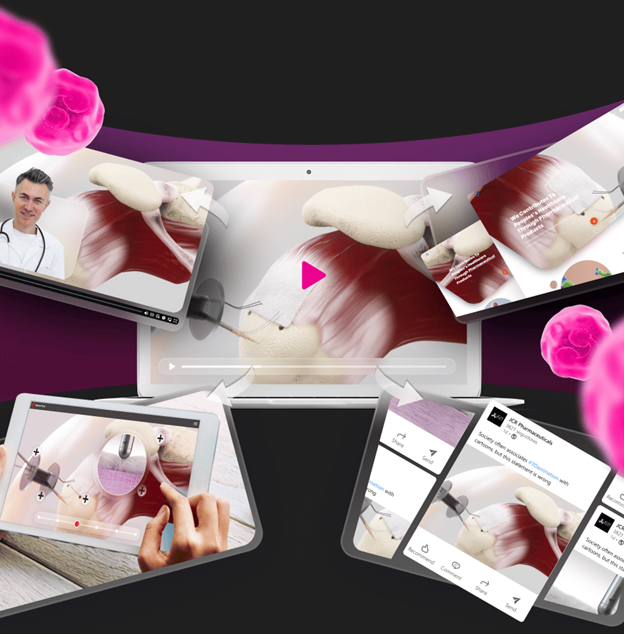
Our modular content blueprint provides the structure needed to operate efficiently.
It includes templates for module architecture, naming conventions, metadata rules, scientific storytelling guidance, visual adaptability rules and alignment with omnichannel activation.
It exists for one reason: to simplify the work of Omnichannel Managers and reduce the friction between global and local teams.
>>Download our modular content blueprint for pharma.
Case Study: Transforming Pharma Content Pipelines With Modular Design
One brand we supported was struggling with long MLR timelines and inconsistent global messaging.
They had dozens of assets in circulation, all telling slightly different versions of their MoA story.
We created a modular content ecosystem built around one validated scientific narrative.
A single MoA animation became a series of micro-modules.
Device content was broken into procedural steps.
Clinical data became reusable cards.
After six months, MLR timelines had improved, reuse increased dramatically and more than two hundred assets were derived from the original modules.
The brand was finally aligned.
Tools and Platforms to Enable Modular Content in Pharma
Veeva Vault PromoMats, Veeva MedComms, IQVIA Content Orchestration and enterprise DAM systems are essential for storing, tagging and distributing modular assets.
These platforms make it possible to automate reuse and maintain consistent scientific narratives across all touchpoints.
Future Trends: AI Assisted Modular Content Creation
AI is accelerating the modular content strategy.
Platforms supported by Anthropic, OpenAI and Deloitte insights are enabling automated tagging, variant generation, consistency checks and predictive personalization.
Although AI cannot replace scientific accuracy or human review, it significantly speeds up the modular workflow and reduces manual work.
Final Thoughts
Modular content in pharma is not a trend.
It is the new operating system for scientific communication.
It brings structure to chaos, speed to MLR workflows and coherence to omnichannel engagement.
And as scientific content demands keep growing, modularity will become the standard that allows marketing teams to scale without losing accuracy or compliance.
FAQs
- What is an omnichannel marketing strategy in pharma
An integrated approach where every channel delivers consistent and personalized scientific communication. - What is the difference between multichannel and omnichannel marketing
Multichannel uses many channels independently. Omnichannel connects them in a unified journey. - Why is omnichannel critical for engaging healthcare professionals
HCPs expect relevant, scientifically accurate interactions across their preferred touchpoints. - How can scientific visual content improve omnichannel engagement
It simplifies complex science, increases recall and ensures consistent messaging across all channels.
Javier M. Floren, Founder of 3DforScience
https://www.linkedin.com/in/javiermartinfloren/
Javier Martín Floren, founder and CEO of 3DforScience, is a benchmark in visual communication for the life sciences sector, with over 12 years leading 3D animation, virtual reality, and scientific storytelling projects for pharmaceutical and biotechnology companies. Recognized as one of the Top 100 Healthtech Exponentialists by Zallud in 2024 and awarded the Leadership Award in Healthcare 2.0 in Dubai 2024, he drives innovation in digital health and the development of new scientific-technological profiles. He also leads ScienceStory, an AI-powered platform that enables scientists and healthcare professionals to create impactful medical animations in an agile and accessible way.