Table of contents
Author: Javier M. Floren, Founder of 3DforScience
Are you interested in modular content and omnichannel materials?
Why immersive tech matters for HCP engagement
The traditional playbook of sending a rep with a static PDF or inviting busy doctors to yet another Zoom call is hitting a wall of digital fatigue.
It is an uncomfortable truth that many of us in the industry are hesitant to admit, but the standard methods of engagement are delivering diminishing returns.
Healthcare professionals are overwhelmed, their attention spans are shorter, and their expectations for digital interaction have skyrocketed.
This is where the conversation shifts toward immersive technologies.
We are seeing a distinct move away from passive consumption toward active participation.
Recent industry observations, including those highlighting top technology trends for 2025, suggest that the future of education lies in environments that demand interaction.
It is no longer enough to show a doctor a chart.
We must invite them into the data.
This is not just about novelty.
It is about solving the very real problem of how to earn a few minutes of a clinician’s valuable time in a crowded digital landscape.

Get this free Guide with
5 key steps for The Digital Transformation
of Scientific Communication
What are XR, AR and VR?
It is common to hear these acronyms used interchangeably in boardrooms, but they represent distinct tools with very different applications.
Extended reality, or XR, is the umbrella term that houses all these immersive formats.
When we talk about XR in a healthcare context, we are referring to the full spectrum of technologies that merge the physical and digital worlds to varying degrees.
Within this spectrum, we find specific tools that serve unique purposes.
Understanding the nuance between them is critical for any Marketing Director planning an omnichannel pharma marketing strategy.
You cannot simply ask for “a virtual project” without knowing whether you need the total immersion of a headset or the accessibility of a smartphone overlay.
For a deeper dive into these nuances, you can explore how XR is transforming healthcare communication.

Virtual reality (VR) in healthcare
Virtual reality is perhaps the most well-known yet frequently misunderstood component of the mix.
VR implies a complete replacement of the user’s environment with a digital one.
In our sector, this is not about gaming. It is about creating a safe, controlled space for high-stakes practice.
The value here is the elimination of risk.
We see this clearly in simulation training where errors can be made without consequence.
Research involving platforms like Oxford Medical Simulation demonstrates that VR simulation improves performance significantly.
By allowing professionals to fail safely in a virtual world, we reduce the likelihood that they will make those same fatal errors on real patients.
Augmented reality (AR) and its role in medicine
Augmented reality takes a different approach by keeping the user anchored in the real world while overlaying digital information on top of it.
This is often more accessible for sales teams and field reps because it can be deployed on tablets or phones that they already carry.
The practical application here is profound for visualizing complexity.
Instead of describing a molecule, AR allows a doctor to see it floating above their desk.
Data from companies like Syandus indicates that these interactive experiences help overcome prescribing barriers.
When a physician can manipulate a 3D object and explore it at their own pace, retention rates climb because the experience is active rather than passive.

Extended reality (XR) and mixed environments
Extended reality is the convergence point.
It creates a continuum where real and virtual elements do not just coexist but interact.
This is the frontier where the most exciting developments are happening, allowing for mixed environments that feel incredibly natural.
We are moving toward a future where the device itself becomes invisible, and the focus shifts entirely to the content.
This blend of environments is crucial for complex surgical planning and advanced educational modules.
To understand where this trajectory is heading, it is worth looking at the future of mixed reality in the healthcare industry.
Benefits of immersive technologies for HCP engagement
The decision to invest in these technologies often meets resistance from finance departments that view them as expensive toys.
However, my experience suggests that when you look at the actual metrics of engagement and retention, the ROI becomes undeniable.
The benefits go far beyond the “cool factor” and strike at the core of educational psychology.
Improved retention and interactive learning
We know that adults learn best by doing.
The passive absorption of information via a slide deck rarely leads to long-term memory formation.
Immersive training creates experiential learning loops that drastically improve retention and confidence.
When a healthcare professional physically performs a procedure in VR, their brain encodes the memory differently than if they had just read about it.
Studies reinforce this, showing that simulation can improve retention and self-confidence.
The physical act of moving and deciding in a 3D space bridges the gap between theory and practice in a way that flat media simply cannot.

Analytics and interaction measurement
One of the most powerful yet underutilized aspects of immersive tech is the data trail it creates.
In a traditional brochure or video, you have no idea if the doctor understood the key message or if they zoned out halfway through.
XR platforms record every decision, hesitation, and interaction.
This allows brand managers to measure user progress with granular precision.
We have seen data showing that interactive scenarios offer built-in analytics that correlate with a 2.5 times improvement in decision-making.
Furthermore, high engagement rates, such as 92% of users continuing to additional scenarios, prove that professionals value this mode of learning.
Competitive differentiation and product marketing
The pharmaceutical market is incredibly crowded.
Launching a new drug with the same old visual aids is a recipe for blending into the background.
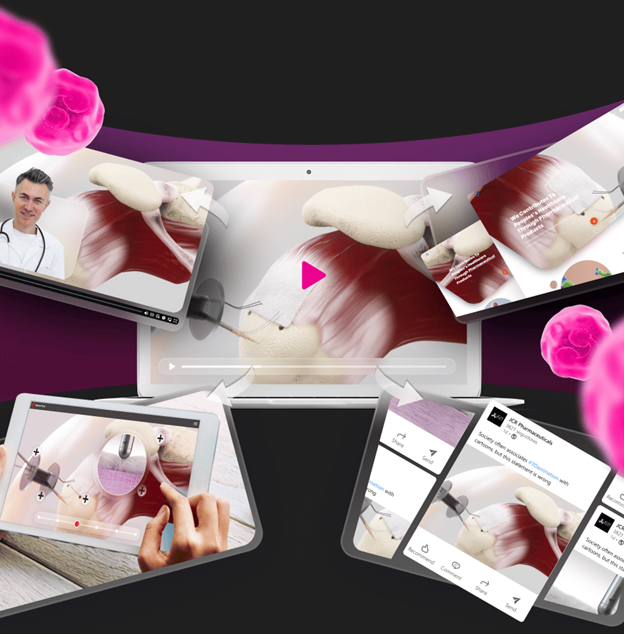
3D and interactive experiences help brands stand out by making the invisible visible.
Complex mechanisms of action are often difficult to explain with words or 2D diagrams.
By letting a doctor step inside the cell or interact with the receptor site, you clarify the science instantly.
>>Download our modular content blueprint for pharma.
Real-world applications in HCP communication
Theory is useful, but we need to talk about execution.
I have seen many companies struggle to find the right use case, often trying to force technology where it does not belong.
The most successful projects are those that solve a specific communication problem.
Medical training and clinical simulation
The most obvious and high-value application is in training.
Using physical mannequins and scheduling lab time is logistically a nightmare and incredibly expensive.
VR simulations allow practitioners to practice procedures whenever they have a spare moment.
The economic argument here is strong.
Studies note that VR training is up to 20 times cheaper than mannequin training when you factor in the scalability and lack of physical setup.
It democratizes access to high-quality training, ensuring that a specialist in a remote hospital has the same learning opportunities as one in a major metropolitan center.
Product demonstrations and 3D scientific visualisation
Marketing Directors often ask how to make a new device or molecule exciting.
The answer lies in 3D scientific visualization.
AR and VR make it easier to understand drug mechanisms or device operations by stripping away the abstraction.
Imagine allowing a cardiologist to place a virtual stent or letting an oncologist explore the tumor microenvironment.
These are not just flashy gimmicks.
They are educational tools that provide clarity.
We have developed numerous molecular maps and anatomical visualizations that transform a five-minute confusing pitch into a one-minute “aha” moment.
Virtual events and remote detailing
The pandemic changed the event landscape forever.
While physical congresses are back, the hybrid model is here to stay.
Virtual environments allow for the organization of conferences and workshops that enable interaction without the cost and downtime of travel.
We have observed that immersive formats help avoid the notorious “Zoom fatigue” that plagues the industry.
By creating a sense of presence, you extend the interaction length.
As indicated by current trends for 2025, providing a rich virtual space keeps attendees engaged far longer than a static video stream ever could.
Patient and professional education
Finally, we must not overlook the patient.
Immersive experiences improve patient education by helping people visualize their own anatomy and pathology.
This empowers them to understand their diseases and adhere to treatments.
For the HCP, this is a tool they can pass on.
AR can guide doctors during procedures, acting as a real-time reference, or they can use the same tool to teach a patient how to use a new injection device.
It builds a bridge of understanding that improves outcomes on both sides of the prescription pad.
How to implement immersive strategies in campaigns for HCPs
Implementing these technologies requires a shift in mindset.
It is not about buying a headset and hoping for the best.
It requires a strategic approach that mirrors software development more than traditional advertising.
Define pilots and measure return on investment
Our advice to any client is always the same: start small.
Do not bet the entire annual budget on an unproven format.
Suggest starting with low-risk pilot projects that focus on a single key objective.
You must measure metrics such as interaction time, retention, and satisfaction from day one.
Use the built-in analytics of these platforms to evaluate results objectively.
When you see the improved decision-making metrics we discussed earlier, you then have the business case to scale up.
Creative and technical considerations
The success of an immersive project lives and dies by the user experience.
If the graphics are glitchy or the controls are unintuitive, you will do more damage than good.
3D design and storytelling are paramount.
It is vital to work with specialists who understand both the medical content and the nuances of XR tools.
At 3DforScience, we tailor 3D animations and immersive environments to the specific scientific narrative of the client.
The creative execution must be as precise as the science it represents.
Regulatory compliance and MLR approvals
We cannot have an honest conversation about pharma marketing without mentioning the Medical, Legal, and Regulatory (MLR) review.
This is often the bottleneck that kills creativity.
However, immersive content is not inherently non-compliant.
The key is to involve the compliance team early.
Explain that the content is closed and controlled.
Platforms today are designed to be MLR-friendly, ensuring there are no “AI surprises” or unapproved pathways.
When legal understands that the experience is a deterministic decision tree, approvals become much smoother.
Success stories and performance data
Nothing validates a strategy like success stories.
The market is beginning to produce solid data that proves the efficacy of these tools.
We are moving past the experimental phase into a time of proven results.
VR simulations in healthcare education: reducing errors and costs
On the training side, the data regarding safety is compelling.
VR provides immersive experiences that improve safety protocols and are significantly cheaper than traditional methods.
Being almost 20 times cheaper than physical mannequin makes VR a financial and ethical imperative for healthcare institutions.
3DforScience case examples
At our own agency, we have seen similar trajectories.
Whether it is interactive presentations for a global launch or mechanism-of-action visualizations for a niche therapy, the feedback is consistent.
Clients report that when they switch from static to immersive, the quality of the conversation changes.
The HCP stops looking at their watch and starts asking questions.
For more details on the specific impact of these projects, you can review our insights on the 10 benefits of virtual reality in healthcare.
AI, digital twins and personalisation
Looking ahead, the convergence of AI and immersive tech is where things get truly interesting.
We are moving toward the era of digital twins and hyper-personalization.
Artificial intelligence will soon power highly personalized virtual assistants that adapt the training scenario to the doctor’s specific knowledge gaps.
Predictive simulations, as suggested by 2025 trend reports, will allow us to model patient outcomes in real-time VR.
Advanced analytics will allow content to be tailored to each HCP, ensuring that no two experiences are exactly alike, maximizing relevance and impact.
Conclusion
To summarize, immersive technologies like XR, AR, and VR are no longer futuristic concepts.
They are practical, measurable tools that solve the most pressing engagement challenges in healthcare.
From the cost savings of VR training to the deep engagement of AR product demos, these technologies offer a way to cut through the noise.
The data is clear: better retention, lower costs, and higher competence.
The only question remaining is how your brand will utilize them.
If you are ready to explore how immersive solutions can fit into your specific campaigns, I invite you to contact our experts at 3DforScience to discuss a pilot project tailored to your needs.
FAQs
What are immersive technologies?
Immersive technologies create digital experiences that make users feel as if they are inside a virtual or augmented environment.
In healthcare, the main types are virtual reality (VR), augmented reality (AR) and extended reality (XR), which blends elements of both.
These tools allow healthcare professionals to interact with three‑dimensional content and simulated scenarios rather than just passively viewing 2D screens.
How can VR improve medical training for healthcare professionals?
Virtual reality simulation gives healthcare professionals the chance to practise procedures in a safe environment without risk to actual patients.
Studies show that VR simulation improves performance and significantly reduces the chance of operational errors.
It also boosts knowledge retention and self‑confidence.
VR training is scalable and up to 20 times cheaper than training with physical manikins, so organisations can offer more practice opportunities.
How does AR benefit healthcare professionals?
Augmented reality overlays digital information onto the real world, adding a layer of data to what the user sees.
In healthcare it can guide surgeons during operations, show anatomical structures in 3D right in the consulting room, and help sales teams demonstrate how a product works.
Interactive AR experiences also help to overcome prescribing barriers and improve retention by allowing professionals to explore information at their own pace.
What is the difference between VR, AR and XR?
VR creates a fully digital environment that users enter via a headset, blocking out the real world.
AR enhances the real world with digital elements, typically through a mobile device or smart glasses.
XR is an umbrella term that covers VR, AR and mixed reality, which combines real and virtual content so that the two interact.
Each technology offers different levels of immersion and is suited to different educational or marketing tasks.
Are immersive solutions expensive to implement?
While the hardware and content development require an initial investment, VR training can be much more cost‑efficient than traditional methods in the long run.
For example, VR simulation has been reported to be up to 20 times cheaper than manikin‑based training due to logistics and scalability.
Digital platforms also scale easily and can be reused across departments.
Platforms like AliveSim show strong returns, delivering a 2.5× improvement in decision‑making and retaining 92 % of users.
How can I measure the impact of immersive technologies?
Modern XR platforms record user interactions and decisions, allowing marketing and medical teams to track progress, engagement and learning outcomes precisely.
For instance, platforms often provide built‑in analytics to see where guidance is needed and to analyse cohorts.
VR simulation tools also offer feedback on performance and can demonstrate reductions in error rates.
By comparing these metrics before and after training, you can quantify improvements in knowledge, confidence and behavioural change.
Javier M. Floren, Founder of 3DforScience
https://www.linkedin.com/in/javiermartinfloren/
Javier Martín Floren, founder and CEO of 3DforScience, is a benchmark in visual communication for the life sciences sector, with over 12 years leading 3D animation, virtual reality, and scientific storytelling projects for pharmaceutical and biotechnology companies. Recognized as one of the Top 100 Healthtech Exponentialists by Zallud in 2024 and awarded the Leadership Award in Healthcare 2.0 in Dubai 2024, he drives innovation in digital health and the development of new scientific-technological profiles. He also leads ScienceStory, an AI-powered platform that enables scientists and healthcare professionals to create impactful medical animations in an agile and accessible way.