Table of contents
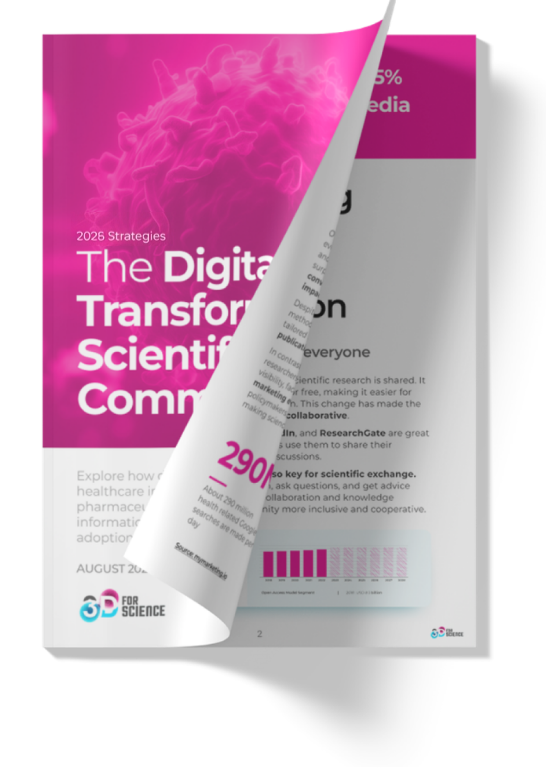
Are you interested in modular content and omnichannel materials?
Get this free Guide with
5 key steps for The Digital Transformation
of Scientific Communication
The paradox no one talks about
Every year, biotech conferences are filled with extraordinary science.
Novel therapies, first-in-class mechanisms, and platforms capable of reshaping entire therapeutic landscapes are presented to rooms full of investors and potential partners.
And yet, most of these innovations fail to generate meaningful traction.
The issue is not scientific quality. The issue is connection.
Across the industry, there is growing recognition that communication, not science, is often the limiting factor.
In fact, a large proportion of investors believe biotech companies struggle to communicate effectively, directly affecting their ability to secure funding and partnerships .
This creates a paradox at the heart of the sector: the more complex and valuable the innovation, the harder it is to make it understood.
The gap between knowledge and understanding
Biotech operates in a language of precision.
Data, pathways, endpoints, and statistical significance define progress.
But investors and strategic partners do not operate in that same language.
They think in terms of risk, timelines, scalability, and return.
This creates a structural disconnect. At conferences, companies present knowledge. What stakeholders need is understanding. The distinction is subtle but decisive. Knowledge informs. Understanding drives decisions.
When this gap is not bridged, even the most promising innovation struggles to move forward.
As many founders experience firsthand, breakthrough science does not guarantee funding.
The determining factor is whether the audience can grasp its relevance and potential quickly enough to act on it.
Why traditional communication formats break down
Despite this reality, most biotech communication still relies on formats that were not designed for this environment.
Dense slides, static figures, and highly technical explanations dominate presentations, forcing the audience to do the cognitive work of interpretation.
That model no longer holds.
Modern biomedical innovation is dynamic by nature.
Mechanisms evolve over time, biological systems interact across multiple layers, and outcomes depend on context.
Attempting to explain this with static content introduces friction at every level.
Even within advanced modeling approaches, the limitation is clear.
Simulations can represent fixed scenarios, but more advanced frameworks such as digital twins evolve continuously with real-world data, reflecting systems as they actually behave rather than as isolated snapshots .
The implication for communication is profound: if the science itself is dynamic, the way it is explained must be dynamic as well.
The internal misalignment that makes it worse
In many biotech organizations, communication is driven primarily by scientific teams.
The intention is correct, but the outcome often is not.
Scientific rigor tends to prioritize completeness and accuracy, while effective communication requires prioritization, structure, and narrative.
The result is a message that is technically correct but strategically ineffective.
This misalignment between scientific and commercial perspectives has been widely observed across the industry, where bridging the gap between complexity and clarity remains one of the central challenges in biotech communication.

From explanation to perception
The companies that consistently succeed at conferences approach communication differently.
- They do not attempt to explain everything.
- They design how their science is perceived.
- They frame the problem before introducing the solution.
- They guide the audience through the mechanism instead of presenting it all at once.
- They connect scientific innovation to real-world impact early, not as an afterthought.
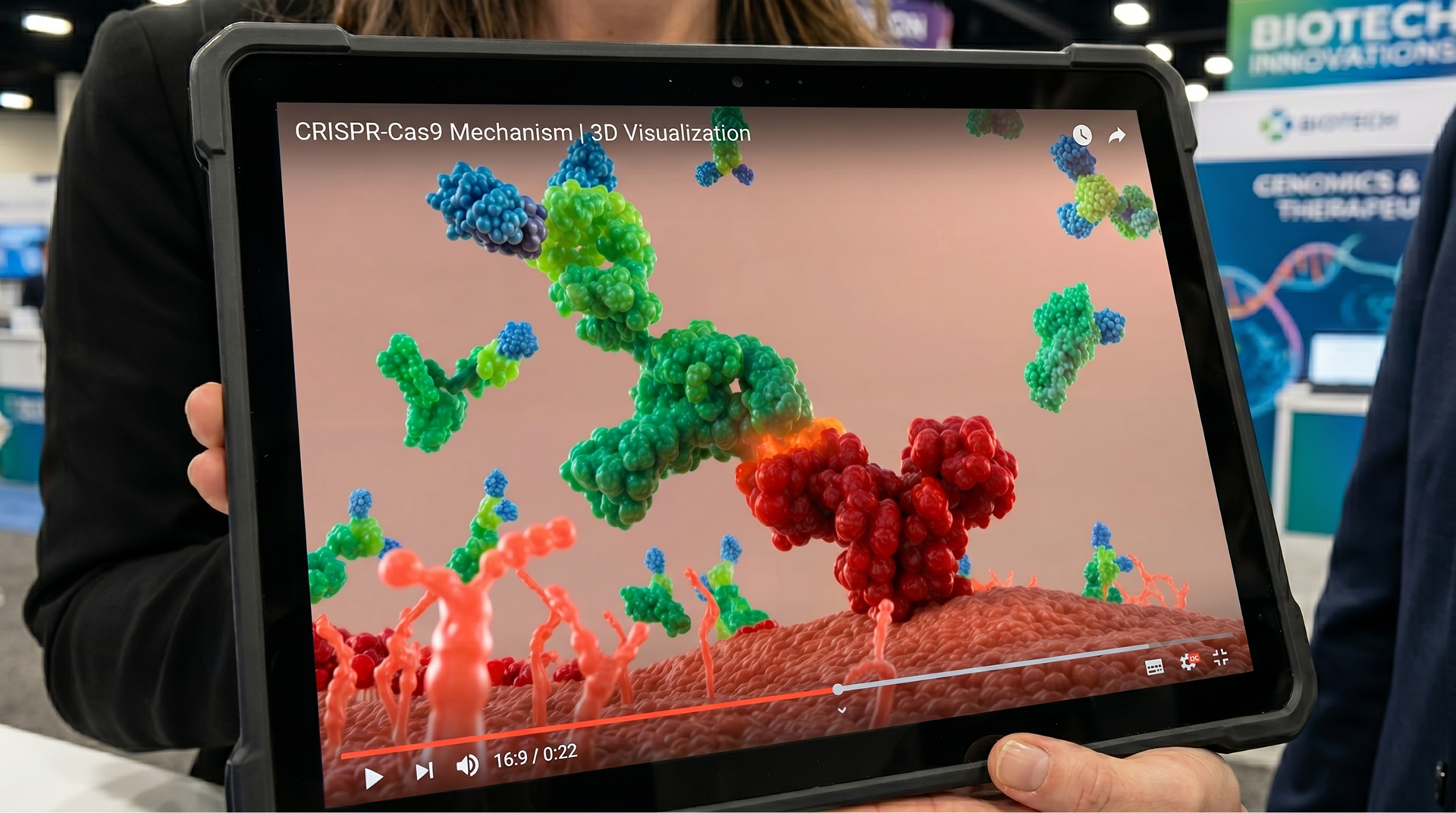
This is where formats like medical animation and scientific illustration become strategically relevant. Not as aesthetic enhancements, but as tools to reduce cognitive load and align interpretation. They transform complex processes into experiences that can be grasped in seconds rather than minutes.
In doing so, they shift communication from explanation to perception.
A structural shift in the industry
The industry itself is already moving in this direction.
As biotech evolves toward precision medicine, complex therapeutic platforms, and integrated health ecosystems, success is no longer determined solely by scientific strength.
It is increasingly defined by the clarity of the value story and its ability to resonate across stakeholders.
This marks a fundamental shift.
Communication is no longer the final layer applied to innovation. It is part of the innovation’s ability to exist in the market.

Conclusion: science is not enough
There is a persistent belief in biotech that great science will eventually speak for itself. In reality, it rarely does.
Science does not compete in isolation. It competes in environments where attention is limited, context is fragmented, and decisions are made under uncertainty.
In those conditions, the winners are not necessarily those with the best science. They are the ones who make their science understandable, credible, and actionable.
Because investors do not fund complexity. Partners do not engage with ambiguity. And no innovation advances if it is not first understood.