Table of contents
- Introduction
- What is Scientific Storytelling?
- The Importance of Storytelling in Marketing for Life Sciences
- Anatomy of a Sticky Story: Adapting the Hero’s Journey to Biotech
- Visuals: The Vehicle for Storytelling in Science
- Three examples of Storytelling Marketing in Pharma
- Frequently Asked Questions about Scientific Storytelling
- Conclusion
Are you interested in modular content and omnichannel materials?
Get this free Guide with
5 key steps for The Digital Transformation
of Scientific Communication
Introduction
I have walked enough congress floors to recognize the pattern.
At events like BIO International or CPHI, brilliant scientists stand beside stunning posters filled with breakthrough data, yet most attendees walk past without stopping.
The molecule may be extraordinary, the data robust, the pipeline promising.
But the message does not stick.
This is the curse of knowledge in life sciences.
We know too much, so we communicate too densely.
In 2025, having a strong compound is not enough.
Attention spans are shorter, competition is fiercer, and differentiation is brutal.
Data informs, but stories inspire.
If your storytelling in science is not deliberate, your innovation risks becoming invisible.
Sticky stories are no longer optional in storytelling marketing.
They are survival tools.

What is Scientific Storytelling?
Scientific storytelling is the intersection of rigorous, validated data and narrative structure.
It translates complex mechanisms, clinical outcomes and technological breakthroughs into coherent stories that the human brain can encode, recall and repeat without compromising medical accuracy.
It is not about simplifying science to the point of distortion.
It is about structuring it so that the Mechanism of Action, the value proposition and the clinical impact are understood as a sequence rather than a collection of isolated facts.
In storytelling marketing pharma, the science remains intact. The delivery changes.
The Importance of Storytelling in Marketing for Life Sciences
The importance of storytelling in marketing becomes obvious when you consider how the brain works.
Neuroscience research consistently shows that people remember stories far better than standalone data points.
Facts activate language processing areas.
Stories activate emotion, memory and sensory pathways simultaneously.
In life sciences, this has three implications:
- First, differentiation: In crowded therapeutic areas, many molecules look similar on paper. A structured narrative helps your brand stand out in a pipeline saturated with incremental improvements.
- Second, memory retention: Busy oncologists do not have time to memorize dense slides. A clear story makes a complex MoA easier to recall during prescribing decisions.
- Third, emotional connection: When the molecule is linked to a patient outcome rather than a statistic, storytelling and marketing converge in a way that drives real engagement.
Anatomy of a Sticky Story: Adapting the Hero’s Journey to Biotech
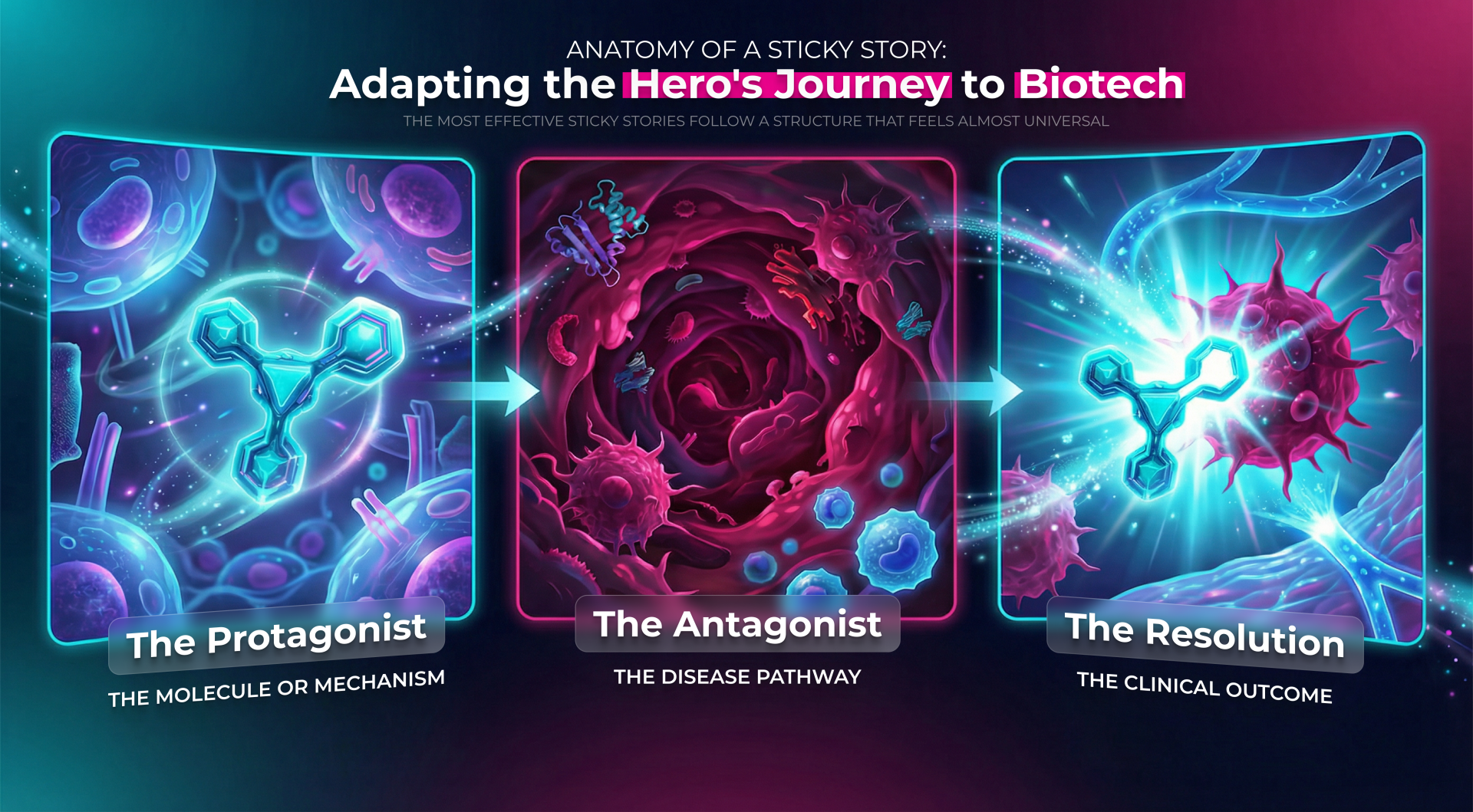
The most effective sticky stories follow a structure that feels almost universal.
In biotech and pharma, this structure maps naturally to how science unfolds, even if we rarely acknowledge it explicitly.
1.- The Protagonist (The Molecule or Mechanism)
In scientific storytelling, the protagonist is often the molecule, the device or the platform technology.
It is positioned as the agent capable of resolving a biological crisis.
Instead of listing features, we show how this mechanism intervenes at a critical moment in the disease pathway.
When a drug is framed as the hero entering a hostile tumor microenvironment or correcting a dysfunctional pathway, the narrative gains momentum.
The science remains rigorous, but the structure creates clarity.
2.- The Antagonist (The Disease Pathway)
Every compelling story needs tension.
In pharma, that tension is the disease pathway.
A tumor microenvironment that suppresses immune response.
A genetic mutation that disrupts protein folding.
A chronic inflammatory cascade that spirals out of control.
By personifying the disease in visual and conceptual terms, storytelling in science creates contrast.
The audience understands what is at stake and why intervention matters.
3.- The Resolution (The Clinical Outcome)
The resolution is the moment the mechanism succeeds.
Binding occurs.
Inhibition blocks progression.
Lysis eliminates target cells.
The pathway stabilizes.
The clinical endpoint is achieved.
Visually and narratively, this is the climax.
It is where the story becomes memorable.
In strong storytelling marketing examples, this moment is not buried in a slide.
It is highlighted as the turning point that defines value.
Visuals: The Vehicle for Storytelling in Science
There is a limit to what text can achieve in complex scientific communication.
When the subject is molecular interaction, immune modulation or device mechanics, words alone struggle.
This is where storytelling and marketing depend on visuals.
Three dimensional animation has become the standard for visualizing the invisible.
A well-designed MoA animation does not just illustrate a process.
It guides the viewer through a narrative arc.
Immersive formats such as VR and AR extend that narrative into experiential chapters, especially in trade show booths or investor presentations.
Interactive tools allow the user to control the pace of the story, turning passive viewing into active exploration.
At 3DforScience, these approaches are central to how we transform scientific data into coherent visual narratives that stay aligned with Medical Affairs approval while enhancing recall.
You can explore more about our work in medical animation and scientific communication on our website and in our medical animation category.
Three examples of Storytelling Marketing in Pharma
Consider oncology.
A product can be presented as a cytotoxic agent that kills rapidly dividing cells, or it can be framed as empowering the immune system to recognize and eliminate malignant cells.
The second approach creates a narrative of activation and defense rather than destruction.
The science is identical.
The perception changes dramatically.
In rare disease, storytelling marketing pharma often shifts from biochemical correction to patient journey.
Instead of leading with pathway diagrams, the narrative begins with delayed diagnosis, frustration and the moment of therapeutic breakthrough.
The molecule becomes the turning point in a human story.
In MedTech, storytelling marketing examples often focus on engineering precision.
A device is not just a tool.
It is a response to a specific surgical challenge.
Animation can show how its design reduces variability and improves outcomes.
The result is a story of mastery rather than mechanics.
Frequently Asked Questions about Scientific Storytelling
How does storytelling apply to B2B pharma marketing?
As Business Horizons confirms in this scientific article, storytelling helps executives, investors and partners grasp complex value propositions quickly.
In B2B settings, clear narrative structure accelerates understanding of pipeline potential and strategic positioning without sacrificing scientific rigor.
Can scientific storytelling maintain medical rigor?
Yes.
Scientific storytelling relies on validated, Medical Affairs approved data.
It does not alter facts. It organizes them into a structure that enhances comprehension and recall.
What makes a story “sticky” in science?
Sticky stories are simple without being simplistic, structured around tension and resolution, and reinforced with strong visual impact.
Clarity, unexpected insight and visual coherence make them memorable.
Conclusion
Complex science needs clear stories.
In life sciences, data alone is not enough. Attention is limited. Competition is intense. The teams that stand out are not necessarily the ones with the most data, but the ones who make it understandable, memorable and meaningful.
Breakthrough results deserve more than a slide full of numbers. They deserve a narrative that helps stakeholders see why it matters.
So here’s the real question:
Is your team using visual storytelling as simple support material… or as a strategic lever to shape perception, alignment and decision-making?
If you are ready to translate your complex pipeline into a compelling visual narrative, contact 3DforScience and let us bring your science to life.